

Google Search Ads are one of the most effective ways to capture high intent traffic, targeting users who are actively searching for your products or services. While they can be quick to launch, achieving strong and consistent performance comes from how well campaigns are set up and then optimised over time.
Below are three key areas we focus on or our own clients to help improve performance and drive better returns from Google Search campaigns.
1. Ad setup
The Ad setup is the key foundation of any Search campaign and something that is often underutilised. With Responsive Search Ads, Google allows up to 15 headlines and 4 descriptions, which are then rotated and combined in different ways to find the best performing combinations. This is a big factor in improving click through rate, known as CTR, which is Ad clicks to views.
We recommend making full use of this functionality. The more variation you give Google, the more it can test and learn what messaging works best for your audience.
A key part of our approach is ensuring relevance from the start. We do this by pinning the main keyword focused headlines into headline 1 positions. This helps make sure the Ad closely matches what the user has searched for, which is a major factor in improving CTR. From there, we allow Google to rotate the remaining headlines into positions 2 and 3 so it can continue testing different combinations and improving performance over time.
For descriptions, there is more flexibility depending on how much control is needed. Google prefers to rotate all descriptions automatically, which can help with optimisation. However, if there is a specific message or structure that needs to be maintained, descriptions can be pinned into line 1 and 2 positions. Only two descriptions show at any one time, so this approach can be useful when tighter control is required.
We recommend:
- Using 10 – 15 headlines and 4 descriptions to maximise variation
- Pinning important keyword headlines into headline 1 for consistency and relevance
2. Keyword research and targeting
Keyword targeting is another area that can have a big impact on performance. It is less about covering every possible search term and more about focusing on the most relevant and high intent queries.
Using Google’s Keyword Planner, you can identify the core terms your audience is searching for. From there, we recommend building a focused list rather than a large one. Google will already match closely related variations, so adding too many keywords can often create overlap rather than improve coverage.
Match type selection is important here. Phrase and Exact match tend to provide the best balance between reach and control, allowing you to target relevant searches without opening the campaign up too broadly. Broad match can sometimes lead to Google interpreting queries too loosely, which could result in Ads showing for searches that are not closely aligned to what you are offering.
We also tend to be cautious with automated expansion features such as AI Max. While these can work well for larger advertisers with bigger budgets, they can use spend quickly for smaller campaigns, while Google tests a wide range of queries. Where they can be more effective is within brand campaigns, where tighter controls can be applied to limit how broad targeting becomes.
Its best to:
- Focus on a smaller set of high intent keywords rather than volume
- Use Phrase and Exact match to keep targeting relevant and controlled
3. Review search queries and build negative keywords
Ongoing optimisation is where a lot of performance gains are made, and reviewing search queries is one of the most important parts of this process. It is also one of the areas that is often overlooked or not done frequently enough.
By analysing the actual search terms that trigger your Ads, you can quickly identify which queries are relevant and which are not. Any that are not relevant can be added as negative keywords, preventing your Ads from showing for those searches again.
This has a direct impact on CTR. By filtering out irrelevant traffic, your Ads are shown more often to users who are likely to be interested, increasing the likelihood of clicks.
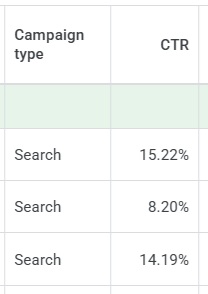
As a guide, the minimum recommended CTR is around 5%, with UK averages typically sitting around 4–5%. Across our campaigns, we are often seeing results at 6 percent or higher, with some reaching between 10% and 20%. As CTR improves, this typically helps reduce the average cost per click over time, allowing more clicks for the same budget.
This is something we consistently work on for our clients, regularly reviewing search queries and expanding negative keyword lists to keep improving performance. Having dedicated resource focused on this area can make a significant difference, particularly over longer periods.
Remember to:
- Regularly review your search queries to maintain relevance
- Build and refine your negative keyword lists to improve CTR over time
Google Search Ads performance is driven by a combination of strong setup and consistent optimisation. By structuring Ads effectively, focusing on the right keywords and regularly refining search queries, campaigns are set up to improve over time and become more efficient.
If you are running Search campaigns and not seeing the results you would expect, or want to improve performance further, this is usually where the biggest opportunities can be found.
If you would like support reviewing your current campaigns or exploring how to improve performance, feel free to get in touch with us at Q Social Media.
